
Conservation of the Santa Cruz River
The importance of the Santa Cruz River to the citizens of Santa Cruz County and greater Southeast Arizona has made its conservation a high priority for many organizations. There has been much recent progress in river conservation, both in Tubac and for the watershed throughout Santa Cruz and Pima Counties. Tubac Nature Center has been active in these efforts and is bringing a focus to the river and lands along it in Tubac. Click below for general information about the Santa Cruz River.
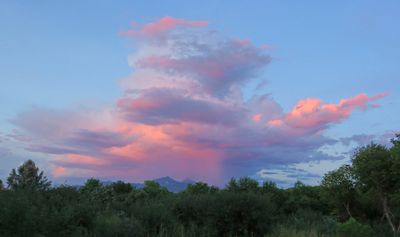
Monsoon over the Santa Cruz River
Santa Cruz River National Wildlife Refuge?

The establishment of a National Wildlife Refuge for the lands near the Santa Cruz River in Santa Cruz and Pima Counties would preserve many miles of river and thousands of acres of land. The Santa Cruz River Coalition is working to support the establishment of the Santa Cruz River Wildlife Refuge. The Nature Center is an active member of the Coalition. The U.S. Fish and Wildlife Service could designate a National Wildlife Refuge in the future. The Sonoran Institute, one of the organizations leading the Coalition, is conducting studies that will support establishment of the refuge. The Coalition is also exploring other options for land preservation along the river.
Tubac Nature Center Conservation Projects

Tubac Nature Center is guiding efforts to preserve and restore the Santa Cruz River and its associated habitats in Tubac. Our efforts aim to enhance ecological and passive recreational values, and will support the preservation of the land. We are working with the landowner and engaging the community. We have received grants worth approximately $120,000 thus far, and are partnering with the Tucson Bird Alliance on these projects.

Tubac Nature Preserve Conceptual Master Plan
In 2023, Tubac Nature Center released a report that serves as a blueprint for the conservation of the river lands in Tubac. This plan is guiding our efforts, and should guide all future efforts for the land. A community workshop involving over 100 participants was held in February 2023 to gain community input that was used to prepare the final Conceptual Master Plan.
Tubac Borrow Pit Wetland Restoration Plan
The Tubac Borrow Pit was excavated in the early 2000s to provide fill to develop the adjacent Barrio de Tubac community. The excavation reached groundwater, which resulted in the development of a wetland and associated riparian habitat that supported many birds and wildlife. The habitat has since degraded due to multiple factors including declining groundwater levels and the establishment of non-native invasive plants such as tamarisk (salt cedar). Wetlands are rare and of exceptional ecological significance in Southeast Arizona, so restoration is a top priority. In 2023, we received a grant from the Santa Cruz Valley National Heritage Area (SCVNHA) to develop a restoration plan for the wetlands in the Tubac Borrow Pit. As part of this grant, the Tucson Bird Alliance began the task of removing tamarisk in the Borrow Pit. Also as part of this grant, we installed an interpretive sign near the Borrow Pit that explains the ecological significance of the Borrow Pit habitats.
Riparian Forest and Grassland Evaluation and Restoration Plan
The 2023 Conceptual Plan identified the cottonwood-willow riparian forest and grasslands as the two other priority Santa Cruz River habitats for restoration. Of particular concern is that riverbank erosion and declining groundwater levels, as well as grazing, are inhibiting the growth of saplings into trees. Over time, as older trees die, this could cause the loss of the forest. In 2024, The Nature Center received another grant from SCVNHA to develop a restoration plan for these two habitats. The grant also supported monthly volunteer work events run by the Tucson Bird Alliance, to remove invasive grasses around the Tubac Borrow Pit. The monthly work events are continuing.
Control of Invasive Trees and Grasses in the Santa Cruz River Floodplain
In 2025, Tubac Nature Center received a grant from the Arizona Department of Forestry and Fire Management (DFFM) Invasive Plant Grant Program to continue our invasive plant control efforts for the next three years. This continued work is essential to the ultimate success of the wetland restoration project for the Tubac Borrow Pit, as well as for the health of the broader ecosystem.
NEXT STEPS
The Nature Center is grateful for the support of the local landowner in our conservation efforts. We will continue to work with the community as we proceed. We recently signed two contracts with the Tucson Bird Alliance for the next steps in our work. The first contract is to conduct monitoring in the Borrow Pit to better understand its hydrology. This will support the engineering design of the Borrow Pit wetland restoration project. The second is a stormwater harvesting project that is part of the wetland restoration plan. This project will channel stormwater runoff into the Borrow Pit from the neighborhood to the west, promoting additional groundwater recharge and supporting the wetland. The Borrow Pit wetland restoration project is expected to cost approximately $500,000 over five years. We will pursue additional grant opportunities, and we ask for your donations to help fund our conservation efforts. We thank you for your support.